
Prime vs Zoom Lenses: Key Differences, Advantages, and When to Use Each
Last updated: March 30, 2026

A lot of lens advice sounds sensible until you are standing in a cramped meeting room, filming an interview with a senior stakeholder who has twenty minutes before their next call.
At that point, the question is not whether prime lenses are more cinematic in theory. It is whether the lens in front of you helps the shoot stay calm, credible, and efficient.
That is why the prime-versus-zoom debate matters less as a gear discussion and more as a production decision. The right choice depends on what the day needs from you: fast framing changes, limited space, contributor confidence, a controlled visual style, or some mix of all four.
For most commercial video, that is the real decision.
Prime vs zoom lenses at a glance
| Aspect | Prime Lenses | Zoom Lenses |
|---|---|---|
| Focal Length | Fixed focal length, such as 35mm or 50mm | Variable focal range, such as 24-70mm or 70-200mm |
| Best Production Fit | Controlled shoots, hero shots, product work, low-light scenes | Interviews, events, case studies, fast-moving production days |
| Working Style | Encourages deliberate framing and camera placement | Allows quick reframing without changing lenses or moving position |
| Speed on Set | Slower if multiple framings are needed | Faster and more adaptable when conditions change |
| Depth of Field | Often shallower due to wider maximum apertures | Usually less shallow, depending on lens and focal length |
| Main Trade-Off | Stronger visual control, less flexibility | More flexibility, fewer interruptions |
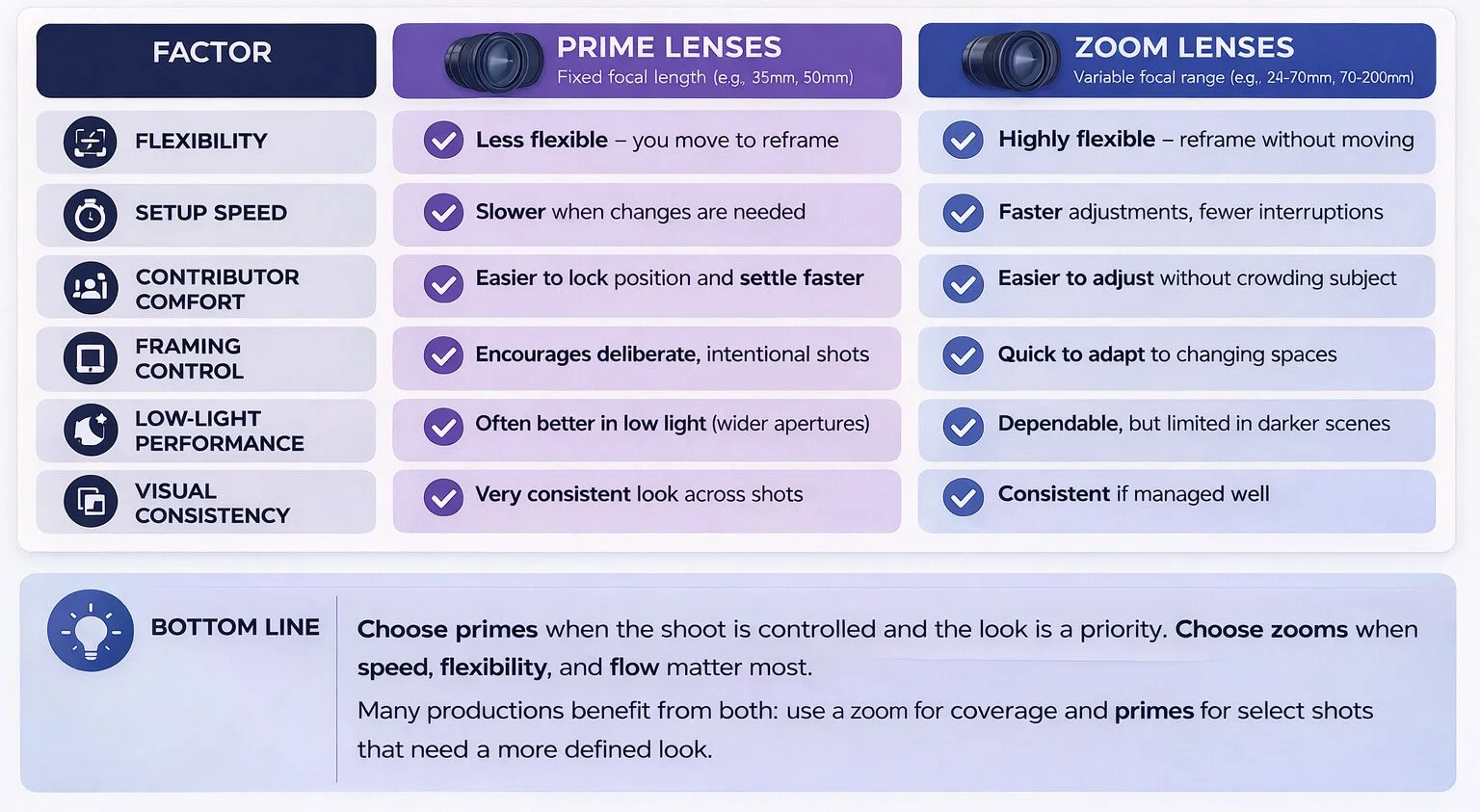
How lens choice affects the shoot day, from setup speed and framing flexibility to contributor comfort and visual consistency.
The Real Difference on a Shoot Day
A prime lens has one fixed focal length. A zoom covers a range.
That technical distinction is simple. What matters is what it changes in practice.
A zoom helps you:
reframe quickly without breaking setup
work faster in tight or awkward spaces
keep interviews moving without constant interruptions
adapt when the room, schedule, or contributor changes the plan
A prime helps you:
commit to a more deliberate framing choice
shape a cleaner visual language
work with wider apertures in lower light
build scenes where camera position and composition are tightly controlled
So this is not really a debate about quality versus convenience. It is a judgement call about how much control the production gives you, and how much flexibility the day demands.
A Quick Note on Sensor Size
Lens choice is not just about the lens itself. Sensor size changes the field of view, so the same focal length can frame very differently depending on the camera body. For example, a 25mm lens on a Micro Four Thirds camera gives a field of view closer to a 50mm lens on full frame. That matters when planning interview framing, room spacing, and lens swaps across different camera systems. If you are comparing primes and zooms, compare how they will actually frame on your sensor, not just the number written on the lens.

Camera sensor sizes comparison
When Zoom Lenses Are Usually the Better Choice
For a large share of business video, zooms are the safer and more useful option.
That is especially true for:
executive interviews
customer case studies
internal communications videos
recruitment content
event filming
documentary-style brand coverage
These shoots often come with limits. The room is smaller than expected. The contributor is nervous. The schedule is compressed. There is no appetite for repeated lens changes while someone is trying to stay relaxed on camera.
In those conditions, a zoom does more than save time. It protects the flow of the shoot.
You can move from a medium interview frame to a tighter crop without stepping into the contributor’s space. You can adjust composition when furniture, sightlines, or background distractions force a last-minute change. You can work through a shot list faster when you need multiple framings before losing the room or the speaker’s patience.
For commercial work, that reliability matters. Clients are not judging lens choice in isolation. They are judging whether the shoot feels organised, whether contributors are handled well, and whether the final footage feels clear and confident.
When Prime Lenses Make More Sense
Prime lenses start to earn their place when the production is more controlled and the visual brief is carrying more weight.
They are often a stronger fit for:
brand films with a more designed look
product sequences and detail shots
campaign assets
scripted scenes
low-light setups where aperture headroom matters
A prime can help when you want stronger subject separation, a more fixed visual language, or a composition that feels carefully chosen rather than adjusted on the fly.
It can also improve discipline on set. With a prime, you are less tempted to solve every framing decision by twisting the barrel a few millimetres. You make a clearer choice about distance, perspective, and camera placement.
That can produce stronger work, but only when the production has the time and control to support that choice.
Practical Trade-Offs on a Production Day
| Production Situation | Usually Better with a Prime | Usually Better with a Zoom |
|---|---|---|
| Single-person interview in a tight office | Only if framing and distance are already locked | Yes, especially if space is limited |
| Brand film with designed hero shots | Yes, where visual consistency matters most | Sometimes, for supporting coverage |
| Fast-moving event coverage | Rarely | Yes, speed and adaptability usually matter more |
| Low-light talking head setup | Often, especially for a shallower background | Possible, depending on the lens speed |
| Case study filming across multiple locations | Useful for selected cutaways | Usually yes, because the day needs range |
| Product close-ups and controlled detail work | Often yes | Sometimes, for flexibility in coverage |
Why the Old “Primes Are Better” Argument Is Too Blunt
Prime lenses still have real advantages. But for most commercial video, image quality is only one part of the equation.
The finished result is also shaped by:
how well the location works
how confident the contributor feels
how quickly the crew can adapt
how consistent the footage is across the day
how restrained the edit feels afterwards
If a zoom helps the team keep a contributor comfortable, protect the schedule, and capture stronger coverage with less disruption, that can improve the final outcome more than a marginal technical gain.
That is why broad lens advice often misses the mark for business video. The better choice is not the one with the strongest reputation. It is the one that best supports the production reality.
A Simple Way to Choose
Choose a zoom lens when:
the day is fast-moving
framing is likely to change
space is restricted
you need speed and continuity
the people on camera are not especially comfortable
Choose a prime lens when:
the setup is controlled
the visual style is more deliberate
you want stronger background separation
lighting is limited
the shot has been designed rather than discovered on set
In many productions, the strongest answer is both. A zoom handles the pace and unpredictability of the day. A prime comes in when a specific shot genuinely benefits from a more controlled look.
Final Takeaway
The most useful lens choice is usually the one that reduces friction without reducing quality.
For business video, that often means choosing the lens that supports the message, the schedule, the room, and the confidence of the person being filmed. Sometimes that is a prime. Very often, it is a zoom.
The aim is not polished performance for its own sake. It is clearer, more natural, more credible communication on camera.
And in practice, that usually comes from better judgement around direction, prompts, room conditions, and editorial restraint, not from pushing a shoot toward a more cinematic setup than it really needs.